

Subsidence insurance claims
My Insurer Wants to Repair the Cracks but Hasn’t Stopped the Subsidence — Is That Enough?
If movement may still be continuing, filling cracks and redecorating may not provide a lasting solution. The important question is whether the insurer’s proposed repair is supported by the evidence and is likely to remain effective.

Is the property still moving?
Will the proposed repair last?
What evidence supports the plan?
Not necessarily. If a property is still moving, repairing the visible cracks without properly addressing the underlying problem can result in the damage returning. The focus should be on whether the proposed repair is appropriate for the cause and condition of the property.
The key question is not simply “Are the cracks being repaired?” Ask what evidence shows that the proposed repair will be effective and lasting if movement is still occurring.
Why repairing the cracks may not solve the problem
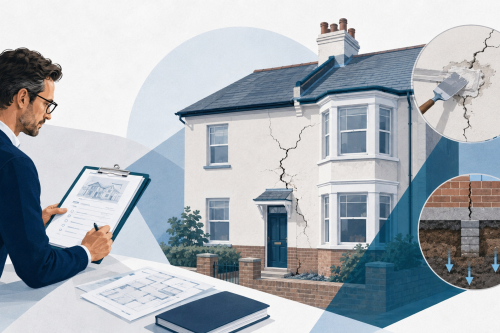
Cracking is often the visible consequence of movement rather than the cause of it. Before significant repairs are completed, the insurer and its experts may therefore need to establish whether the movement has stabilised and whether anything further needs to be done about its cause.
That does not mean every property affected by subsidence needs underpinning. Depending on the evidence, the appropriate response might involve drainage repairs, vegetation management, monitoring, localised structural work or another form of stabilisation.
What matters is whether the insurer can explain why its proposed approach should provide a proper repair in the circumstances of your claim.
What does the Financial Ombudsman look at?
The Financial Ombudsman Service says it expects repairs in subsidence cases to be effective and lasting. It looks at expert opinions about the repair, whether the insurer investigated the movement properly and whether the proposed work will fully put right the insured damage for an appropriate period.
The Ombudsman also says that, in some cases, achieving an effective repair may require work to damage or causes that are not themselves covered under the policy.
In a published subsidence case, an insurer proposed repairing the visible damage even though its engineering evidence indicated that movement was likely to continue without stabilisation. The Ombudsman concluded that a repair likely to fail and require repeated crack repairs was not an adequate long-term solution.
See the Financial Ombudsman’s subsidence and ground-movement guidance.
What evidence should support the repair plan?
Do not focus only on the appearance of the cracks. The useful evidence is the material that explains what caused the movement, whether it is continuing and why the proposed repair should work.
Movement monitoring
What do the crack or level-monitoring results show, and has the insurer concluded that the property is now stable?
Engineering opinion
What does the structural engineer actually recommend, and are there qualifications or warnings in the report?
Cause of movement
Has the likely cause been identified, such as clay shrinkage, vegetation, leaking drains or another ground condition?
Cause addressed
If a contributing cause has been identified, what has been done about it before the cosmetic or structural repair begins?
Repair specification
Does the schedule of works explain how the repair will restore the property rather than simply cover the visible cracking?
How can you tell whether the property is still moving?
Subsidence claims can require monitoring because movement may be seasonal. The Financial Ombudsman says a thorough investigation may sometimes involve monitoring across a year, as well as information about foundations, soil, drains and the development of cracking.
Relevant material can include crack-monitoring results, level surveys, structural reports, trial-pit or soil information, drainage CCTV, arboricultural evidence and dated photographs showing how the damage has developed.
If the insurer says the property has stabilised, ask which evidence supports that conclusion and whether its engineer considers the proposed repairs suitable for the level of movement recorded.
Underpinning is not automatically the answer
It can be tempting to assume that a subsidence claim has only been properly resolved if the property is underpinned. That is not the test. Underpinning is one possible remedy, but it may be unnecessary where another proportionate solution is capable of stabilising the property.
Equally, an insurer should not dismiss stabilisation work simply because it is expensive if the evidence shows that a lesser repair is unlikely to provide a lasting result.
Our main subsidence and ground-movement claim page explains the wider issues that can arise with causation, monitoring, repair proposals and insurer decisions.
What if the cracks return after the repair?
Cracks returning does not automatically prove that the original repair was wrong. But recurring damage can raise an important question: was the movement genuinely stable and was the chosen repair appropriate?
Photograph the new damage, record when it appeared and tell the insurer promptly. Ask whether the claim will be reopened, whether further monitoring is required and whether the previous engineering conclusions need to be reconsidered.
If the insurer’s work itself has caused additional damage, that should also be documented. The Financial Ombudsman specifically identifies poor repairs, insufficient repairs and repairs causing further damage among the types of subsidence complaints it sees.
What should you ask the insurer now?
A short, focused request can be more useful than a long complaint. Ask the insurer to confirm:
- whether it considers the property to be stable;
- the evidence supporting that conclusion;
- the identified cause of the movement;
- whether that cause has been addressed;
- what its engineer recommends before repairs begin;
- why the proposed repair is expected to be effective and lasting; and
- what will happen if movement or cracking returns.
A useful question to put in writing: “Please explain what technical evidence shows that the proposed repairs will provide an effective and lasting solution, particularly if movement has not conclusively stopped.”
What if you disagree with the insurer’s repair plan?
Ask for the engineering reports, monitoring data and complete schedule of works relied upon. If there is a competing expert opinion, identify the precise point of disagreement rather than simply sending another report and asking the insurer to reconsider.
If the issue cannot be resolved through the claims team, you can make a formal complaint. An eligible unresolved complaint may then be referred to the Financial Ombudsman Service. The Ombudsman can consider the insurer’s investigation, expert evidence and repair approach.
You can read our guidance on preparing an insurance complaint before submitting it to the Financial Ombudsman.
How Insurance Dispute Service may help
If your insurer has accepted the subsidence claim but you are concerned that the proposed work will only repair the visible damage, Insurance Dispute Service can review the repair proposal, engineering reports, monitoring information, policy wording and correspondence.
The aim is to identify whether the insurer’s approach appears supported by the available evidence, which issues genuinely remain in dispute and what proportionate next step may be available.
You can start a free claim review and send us the insurer’s proposed repair schedule together with any engineering or monitoring reports you have received.
Your free complaint options
You do not need to use a claims management company to complain to your insurer. You can complain yourself for free. If eligible, you can also refer an unresolved complaint to the Financial Ombudsman Service yourself for free.
Official sources and further reading
- Financial Ombudsman Service: subsidence and other types of ground movement
- Financial Ombudsman Service case study: insurer liability for stabilisation work
- Financial Ombudsman Service: settling home insurance claims
This article provides general information, not legal advice. The correct repair, complaint route and outcome depend on the policy wording, technical evidence and individual circumstances.
Free initial review
Concerned the Subsidence Repair Won’t Last?
Send us the repair proposal, engineering evidence and monitoring information. We can review what the insurer is relying upon and explain the realistic next steps.