

Financial Ombudsman Decisions
Insurance Disputes: Let Down by the Ombudsman?
If your insurance complaint has not been upheld, the Ombudsman’s answer can feel like the end of the road. But an unsuccessful Ombudsman complaint does not necessarily answer every question about the underlying insurance dispute.
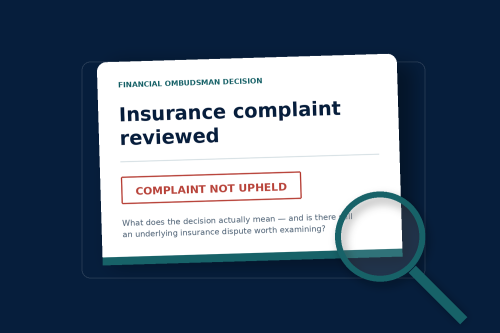
Financial Ombudsman Decision
Insurance complaint reviewed
Complaint Not UpheldWhat does the decision actually mean — and is there still an underlying insurance dispute worth examining?
1
Understand what the Ombudsman actually decided
2
Identify evidence or legal issues that may remain
3
Consider barrister or litigation routes where justified
You challenged your insurer. You gathered the documents, explained why you believed the decision was wrong and took the dispute to the Financial Ombudsman Service. Then the answer arrived: complaint not upheld.
For many policyholders, that can feel final. The insurer has already rejected or underpaid the claim and an independent dispute-resolution body now appears to have agreed with it.
But an unsuccessful Ombudsman complaint does not necessarily answer every question about the underlying insurance dispute.
The Financial Ombudsman Service is not a court. It resolves individual financial-services complaints on what it considers to be a fair and reasonable basis, taking account of relevant law, regulatory rules, codes and good practice.
For a policyholder facing a substantial loss, the question after an unsuccessful Ombudsman complaint may therefore become:
Was the underlying insurance claim genuinely weak — or is there still a dispute worth examining?
Not every insurance complaint is upheld
Financial Ombudsman Service data for 2025/26 shows that uphold rates differed considerably between types of insurance complaint.
38%
Buildings insurance
39%
Commercial property insurance
35%
Car or motorcycle insurance
36%
Travel insurance
These are published historic uphold rates, not the odds of success in an individual complaint. An Ombudsman outcome depends on the particular policy, evidence and circumstances.
First, establish what stage your Ombudsman complaint has reached
There is an important difference between a case handler or investigator’s assessment and a final decision issued by an Ombudsman.
If either side disagrees with an investigator’s assessment, the complaint can in appropriate circumstances be referred to an Ombudsman for a formal final decision. An unfavourable investigator’s view is therefore not necessarily the end of the FOS process.
Once an Ombudsman issues a final decision, however, there is no appeal to another Ombudsman simply because one side disagrees with the outcome.
Investigator or case-handler assessment
There may still be an opportunity to identify errors, provide further evidence and ask for the complaint to be referred to an Ombudsman.
Ombudsman final decision
The FOS complaint process has reached its final stage. The next questions concern acceptance of the decision and any underlying legal rights.
Understand what the Ombudsman actually decided
Do not reduce a detailed Ombudsman assessment to: “They agreed with the insurer.”
Identify the point that actually decided the complaint.
- Did the Ombudsman conclude that a policy exclusion applied?
- Was the insurer’s expert evidence preferred?
- Was the cause of the loss not established?
- Was there insufficient evidence of the amount claimed?
- Did the dispute concern non-disclosure or misrepresentation?
- Was underinsurance or a policy condition decisive?
- Was an argument raised but ultimately considered irrelevant to the outcome?
Any further review should concentrate on the part of the case that actually failed rather than simply reproducing the original complaint.
Why might a policyholder remain dissatisfied?
Insurance disputes can be technically difficult. A decision may depend on competing expert reports, the interpretation of several policy provisions, disputed causation, complex financial calculations or evidence accumulated over months or years.
A policyholder may believe too much weight was placed on the insurer’s loss adjuster or engineer. They may have evidence that does not appear to have been addressed. They may disagree with an assumption about when damage occurred. Or the dispute may have developed into a legal question about what the insurance contract actually requires.
None of those points automatically establishes that the Ombudsman was wrong. But they can justify a more useful question:
What would have to be demonstrated for a different conclusion to be sustainable?
Evidence often matters more than repeated argument
A recurring problem in insurance disputes is that policyholders keep repeating a proposition without strengthening the evidence behind it.
Consider a rejected property claim. The insurer says the damage developed gradually. The policyholder says it happened suddenly.
If the dispute turns on technical causation, repeating that the damage was sudden may not move the case forward. A properly instructed surveyor or engineer explaining why the physical evidence is inconsistent with gradual deterioration potentially could.
The same principle can apply to valuations, business interruption losses, vehicle values, medical evidence and other technical disputes.
Was the argument wrong — or was the evidence insufficient to prove it? Those are not the same thing.
Has the real insurance issue been identified?
Long insurance complaints often contain dozens of legitimate frustrations. The insurer delayed. Emails were ignored. Different figures were quoted. The policyholder had to chase repeatedly. The claim caused considerable disruption.
All of those matters may be relevant. But they may not decide whether the insurer owes the underlying claim.
The decisive question might instead be:
- Did the exclusion relied upon actually apply?
- What caused the damage?
- Was there a qualifying misrepresentation when the policy was arranged?
- Was a policy condition breached and what was the legal consequence?
- Has the insurer correctly calculated the business interruption or property loss?
A complaint can become weaker when the decisive insurance issue is buried beneath everything else that went wrong.
What if you think important evidence was overlooked?
Start by being precise.
Which evidence? What did it establish? Which conclusion does it contradict? Why would considering it properly have made a material difference?
Saying: “They ignored all my evidence” is unlikely to be as useful as identifying a specific factual finding and the documents that appear to contradict it.
For example, an assessment may conclude that no maintenance took place during a particular period, while dated inspection and service records appear to show otherwise. That turns a general complaint into an identifiable evidential issue.
What if the insurer’s expert evidence was preferred?
This can be particularly frustrating. But the answer is rarely simply to attack the expert because they were instructed by the insurer.
The stronger approach is usually to examine the substance of the opinion.
- What assumptions were made?
- What inspection was actually carried out?
- What evidence was considered?
- Was relevant evidence omitted?
- Is the methodology sound?
- Does another appropriately qualified expert disagree — and explain why?
If the technical evidence is the reason the complaint failed, that may be where any further analysis needs to begin.
A rejected Ombudsman complaint does not become a court appeal
If an Ombudsman has issued a final decision, you cannot appeal that decision to another Ombudsman simply because you disagree with it.
A court claim against the insurer would normally be something different: litigation of the underlying legal dispute rather than an appeal asking a court to substitute its view for the Ombudsman’s.
Judicial review is different again. It generally concerns the lawfulness of the Ombudsman’s decision-making process rather than simply asking a court to reconsider the facts and evidence because one party disagrees with the result.
The practical question for many policyholders is not: “How do I appeal the Ombudsman?” It is: “Is there still a viable legal claim against the insurer?”
Think carefully before accepting a final Ombudsman decision
If a complainant accepts an Ombudsman’s final decision within the specified timeframe, the financial business must comply with it.
The Financial Ombudsman Service also explains that after accepting a final decision it is unlikely the complainant will then be able to pursue the business through the courts for the same complaint.
If the complainant rejects the final decision, the FOS process ends and the business does not have to comply with it. The complainant may still be able to take legal action against the business.
Where a substantial insurance claim or potential litigation is involved, independent legal advice may therefore be sensible before deciding whether to accept a final decision.
Do not assume the Ombudsman process stops a court deadline
Insurance disputes can be subject to statutory limitation periods and other procedural deadlines. The correct deadline depends on the legal claim and individual circumstances.
An Ombudsman complaint and court proceedings are different processes. If there is a realistic possibility that litigation may ultimately be required, limitation should be considered separately and early.
A substantial insurance claim should not be allowed to become legally unenforceable simply because attention remained focused exclusively on the complaints process.
The Financial Ombudsman framework is also changing
In March 2026, HM Treasury announced what it described as the most significant package of reforms to the Financial Ombudsman Service since its inception.
The Government said the proposed reforms are intended to restore clarity to the financial services redress system, strengthen consistency between the Ombudsman and the Financial Conduct Authority and provide greater certainty for both consumers and firms.
The FCA and Financial Ombudsman Service have also been progressing changes intended to improve the speed, consistency and predictability of redress. The FCA updated its modernising-redress work again in August 2026 following publication of a Financial Ombudsman policy statement.
Those reforms should not be presented as evidence that individual Ombudsman decisions are generally wrong. They do, however, demonstrate that the operation and boundaries of the redress framework remain the subject of significant regulatory and legislative attention.
If the Ombudsman has said no, what should you examine next?
An unsuccessful complaint should trigger an objective review rather than an automatic decision to fight on.
Start with the complete file:
- the insurance policy and schedule;
- the insurer’s original decision;
- expert, loss-adjuster or valuation reports;
- the evidence originally submitted;
- the investigator’s assessment where relevant;
- the Ombudsman’s provisional or final decision;
- the chronology of the dispute.
Then reduce the matter to four questions.
Policy
Was the insurance contract interpreted correctly?
Facts
Were the material facts properly established?
Evidence
Was the necessary evidence available and properly developed?
Legal route
Is there a viable legal route capable of producing a materially different outcome?
Sometimes the answer will be no. That is important to know. Continuing into weak litigation simply because an Ombudsman complaint was unsuccessful can turn one disappointment into a much more expensive one.
In other cases, the review may identify evidence that needs strengthening, a legal issue requiring specialist analysis, an expert conclusion capable of proper challenge or a contractual issue that has never really been tested.
When a specialist barrister may add value
For a substantial or legally complex insurance dispute, one option may be obtaining an opinion from a specialist barrister.
For suitable matters, consumers and businesses may be able to instruct an authorised barrister directly through the Public Access scheme.
The purpose should not simply be to find somebody willing to disagree with the Ombudsman. A useful barrister’s opinion should examine the underlying insurance case.
- What does the insurance contract require?
- What legal arguments are genuinely available?
- How strong is the evidence?
- Where are the weaknesses?
- What further factual or expert evidence may be needed?
- What is the realistic prospect of succeeding in court?
- What are the likely cost and procedural risks?
Insurance Dispute Service can help organise and prepare suitable cases so that specialist counsel receives a structured policy, chronology, evidence set and statement of the disputed issues rather than an unorganised complaint file.
Litigation is different from an Ombudsman complaint
The Financial Ombudsman process is deliberately less formal than court proceedings. Litigation operates differently.
- A legally recognised cause of action must be identified.
- The parties’ cases must be pleaded and defined.
- Documentary evidence may need to be disclosed.
- Expert witnesses may have formal duties to the court.
- Court procedure and evidence rules apply.
- Litigation can create costs and adverse-costs exposure.
A case that did not succeed through the Ombudsman is therefore not automatically incapable of succeeding in court. Equally, an argument that sounded persuasive in correspondence is not automatically a viable legal claim.
Moving from an Ombudsman complaint towards litigation requires a fresh assessment of the underlying claim, evidence, law, value, costs and deadlines.
How Insurance Dispute Service can help after an unsuccessful Ombudsman complaint
Insurance Dispute Service can review an existing or unsuccessful insurance complaint to establish where the dispute now stands.
That may include:
- examining the insurer’s original decision;
- reviewing the relevant policy wording;
- analysing the investigator or Ombudsman reasoning;
- identifying the central disputed issues;
- organising the chronology and supporting evidence;
- identifying where expert evidence may need strengthening;
- preparing suitable cases for specialist barrister advice;
- providing practical litigation support where the underlying dispute justifies further legal action.
The purpose is not to promise that an unsuccessful Ombudsman complaint can somehow be “overturned”.
It is to answer a more important question:
Is there still a credible insurance dispute — and if there is, what is the strongest realistic route forward?
Frequently asked questions
Can I appeal a final Ombudsman decision?
You cannot appeal a final decision to another Ombudsman simply because you disagree with it. Depending on the circumstances, judicial review may address the lawfulness of the decision-making process, while separate legal proceedings may sometimes be available against the financial business in relation to the underlying dispute.
Can I still take my insurer to court after the Ombudsman?
Potentially. The Financial Ombudsman Service states that where a complainant rejects a final decision, they may still be able to take legal action against the business. The viability of litigation depends on the underlying legal claim, evidence, value, costs and relevant deadlines.
What happens if I accept the Ombudsman’s final decision?
If a final decision is accepted within the specified timeframe, the business must comply with it. The FOS also says it is unlikely the complainant will then be able to pursue the business through the courts for the same complaint.
Does an Ombudsman complaint stop the limitation period for court proceedings?
Do not assume that it does. Court limitation and procedural deadlines should be considered separately. Obtain appropriate legal advice promptly where litigation may be required.
Can Insurance Dispute Service review a case that has already been to the Ombudsman?
Yes, subject to an initial assessment of the matter. The review can consider the policy, insurer’s reasoning, evidence and Ombudsman material to help identify whether a credible underlying dispute remains and what further route may be realistic.
Official sources and further reading
- Financial Ombudsman Service: how complaints are resolved and final decisions
- Financial Ombudsman Service: annual complaints data 2025/26
- Financial Ombudsman Service: Q1 2026/27 complaints data
- HM Treasury: Financial Ombudsman Service reform
- Financial Conduct Authority: Modernising the Redress System
This article provides general information, not legal advice. FOS jurisdiction, acceptance of decisions, court rights, limitation, litigation prospects and costs depend on the particular facts and legal circumstances.
Let Down by the Ombudsman?
The Remaining Question Is Whether the Evidence and Law Say the Same Thing.
If you believe an important insurance issue remains unresolved, we can help examine the underlying dispute and identify the strongest realistic next step.